Introduction
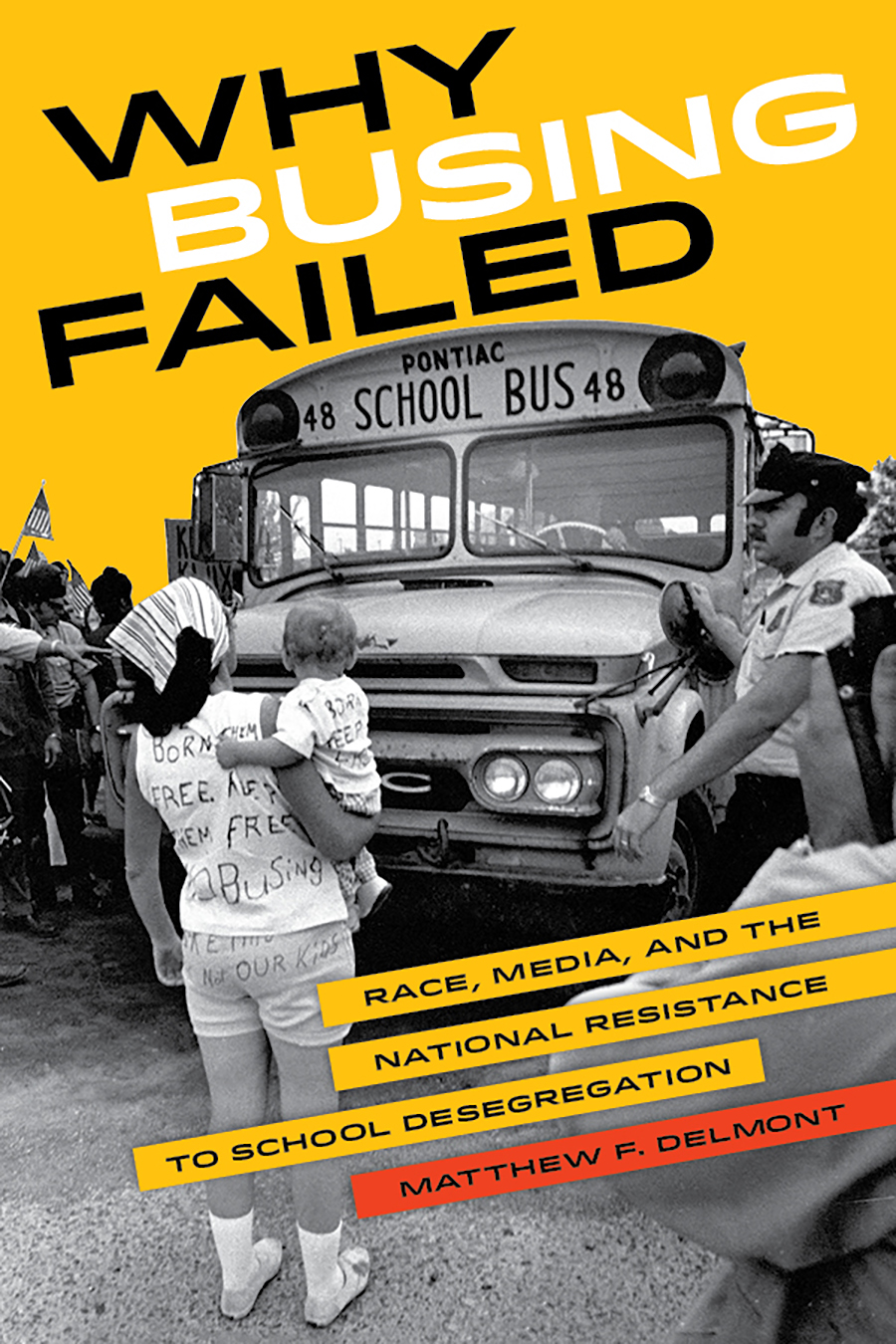
My goal in writing Why Busing Failed is to change how we talk about and teach the history of "busing" for school desegregation. Rather than using "busing" as a politically neutral word, we need to understand that this term developed as a selective way to label and oppose school desegregation. The long history of "busing" for school desegregation is more nuanced, complicated, and important than any one city’s "busing crisis." My hope is that by seeing the history of "busing" clearly and speaking honestly about the history of civil rights, people who care about educational equality can chart a more just future.
This companion website [currently under construction] to Why Busing Failed highlights
12 Ways to Teach "Busing" Differently:
1) Talk about busing to maintain school segregation before "busing"
Millions of students rode school buses to school before "busing" became a political issue. More importantly, school buses had long been used in the South and as well as New York, Boston, and many other northern cities, to maintain segregation. Students rode buses past closer neighborhood schools to more distant segregated schools. Read more...
2) Start in 1950s New York rather than 1970s Boston
While most people associate "busing" with Boston in the mid-1970s, the battles over "busing" first emerged in New York in the 1950s and 1960s. Resistance to school desegregation developed alongside civil rights protests in New York in the decade after Brown, with white parents and politicians first objecting to rumored plans to bus students between Harlem and Staten Island and then organizing rallies to oppose plans to transfer students between predominantly black and Puerto Rican schools and white schools. Read more...
3) Study the antibusing provisions in the Civil Rights Act of 1964
The Civil Rights Act of 1964 was landmark legislation that promoted racial equality, it also included language added by Northern congressmen that drew a sharp distinction between segregation by law in the South and so-called "racial imbalance." These amendments and antibusing provisions were designed to keep federal civil rights enforcement of school desegregation focused away from the North, and white politicians and parents in Boston, Chicago, New York and elsewhere regularly pointed to the 1964 Civil Act to justify the maintenance of white schools. Read more...
4) Discard the myth of de facto segregation
While civil rights advocates initially promoted a distinction between “southern-style” and “northern-style” segregation to build a political consensus against Jim Crow laws in the South, the de jure–de facto dichotomy ultimately made it possible for public officials, judges, and citizens in both North and South to deny legal responsibility for the visible realities of racial segregation. Over the past two decades scholars have revealed the vast web of governmental policies that produced and maintained racially segregated neighborhoods and schools in the North, as well as highlighting the civil rights activists who fought against these structures of racial discrimination. These studies provide overwhelming evidence that, in every region of the country, neighborhood and school segregation flowed from intentional public policies, not from innocent private actions or free-market forces. Read more...
5) Feature civil rights activism in the North
Civil rights activists, parents, and students in Northern cities were organized, creative, and persistent in their protests of school segregation and educational inequality. In cities like Boston, Chicago, and New York, civil rights advocates lobbied school officials, filed lawsuits, and organized massive school boycotts in the 1960s. Once the school desegregation story became framed around “busing” and “white backlash” in the late 1960s, it was easy to forget that black people and their allies had fought for years to secure equal education or that powerful local officials underwrote school segregation in the North. Read more...
6) Describe how the news media covered civil rights differently in the North and South
The news media’s support for the Southern civil rights movement is one of the iconic stories we tell about race in America, but it is limited and limiting story. If television was successful in framing the southern civil rights struggle as a moral imperative, the news media did not present civil rights activity in the North with the same moral clarity. Whereas television helped underscore the urgency of the black civil rights movement in the South in the 1950s and 1960s, by the mid-1960s and 1970s white “antibusing” protestors received the vast majority of media attention. Whatever praise television news personnel deserve for advancing civil rights in the South must be tempered by the fact that television news advanced the resistance to school desegregation as a national story with the same vigor. Read more...
7) Examine how one week in Chicago changed the history of school desegregation
Title VI of the Civil Rights Act gave the U.S. Department of Health, Education, and Welfare (HEW) authority to withhold funds if school districts failed to comply with rules against school segregation. In 1965, HEW briefly withheld $30 million in federal funds from Chicago, finding the city’s schools to be in “probable noncompliance” with Title VI’s antidiscrimination provision. Facing pressure from Mayor Richard J. Daley, Senator Everett Dirksen, Illinois congressmen, and President Lyndon Johnson, HEW’s case in Chicago quickly unraveled, despite overwhelming evidence that Chicago school officials were not innocent bystanders to the creation and maintenance of racially differentiated schools. HEW’s surrender in Chicago encouraged school officials and politicians in other cities to maintain positions of resistance and noncompliance with regard to “busing” and school desegregation. Read more...
8) Talk about Richard Nixon's antibusing presidency
9) Highlight how antibusing parents and politicians made savvy use of television and print news to oppose "busing"
10) Explore what "busing" meant to black communities
11) Move beyond Common Ground
12) Emphasize the rights of black students rather than the feelings of white people